
Azadirachta indica A. Juss.
Description
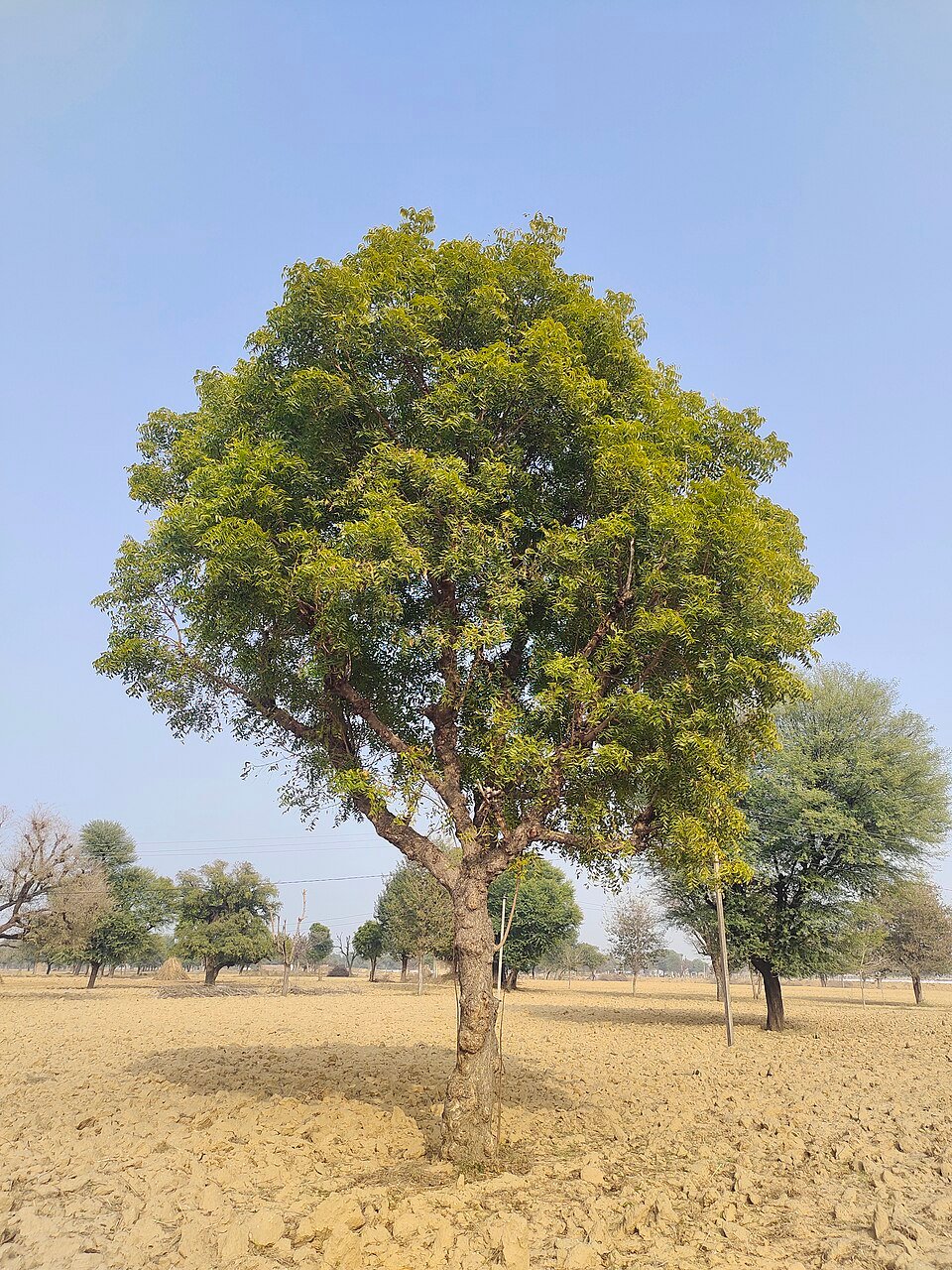
Azadirachta indica is a medium to large-sized evergreen or semi-evergreen tree, usually 10–20 m tall, occasionally reaching more than 25 m under favourable conditions. The trunk is straight with a rounded spreading crown. Bark is greyish-brown, rough, and fissured in older trees. Young branches are greenish and glabrous. Leaves are compound, alternate, and imparipinnate, usually 20–40 cm long, with 8–19 leaflets arranged along a central rachis. Leaflets are lanceolate to ovate-lanceolate, 3–8 cm long, with serrated margins, acute apex, and a glossy dark green upper surface. Leaves may shed partially during dry periods. Flowers are small, bisexual or functionally unisexual, actinomorphic, and fragrant, arranged in axillary or terminal panicles. Flowers are white to creamy-white, with five free petals and ten stamens united into a staminal tube surrounding the ovary. The ovary is superior and composed of three carpels. Fruits are small ellipsoid drupes, initially green and becoming yellowish when mature. Each fruit usually contains a single hard seed enclosed within a thin fleshy pulp.
Diagnostic Characters
Distribution
Native range: Native to Indian subcontinent, Myanmar.
In Pakistan: Widely distributed in Pakistan, India, Bangladesh, Sri Lanka. Commonly planted throughout Pakistan.
Phenology
Ethnobotany & Uses
Hello! I'm UniFlora AI. Ask me anything about Neem (*Azadirachta indica*) — identification tips, flowering season, uses, campus locations, or taxonomy.
Powered by UniFlora knowledge base.
Where it grows on campus
Taxonomic Notes
Azadirachta indica belongs to Meliaceae, the mahogany family, characterized by Compound leaves, Panicle inflorescences, Staminal tubes, Drupaceous fruits.
References
- Plants of the World Online (POWO), Royal Botanic Gardens, Kew.
- World Flora Online — Azadirachta indica A.Juss.
- Flora of Pakistan, eFloras.org.