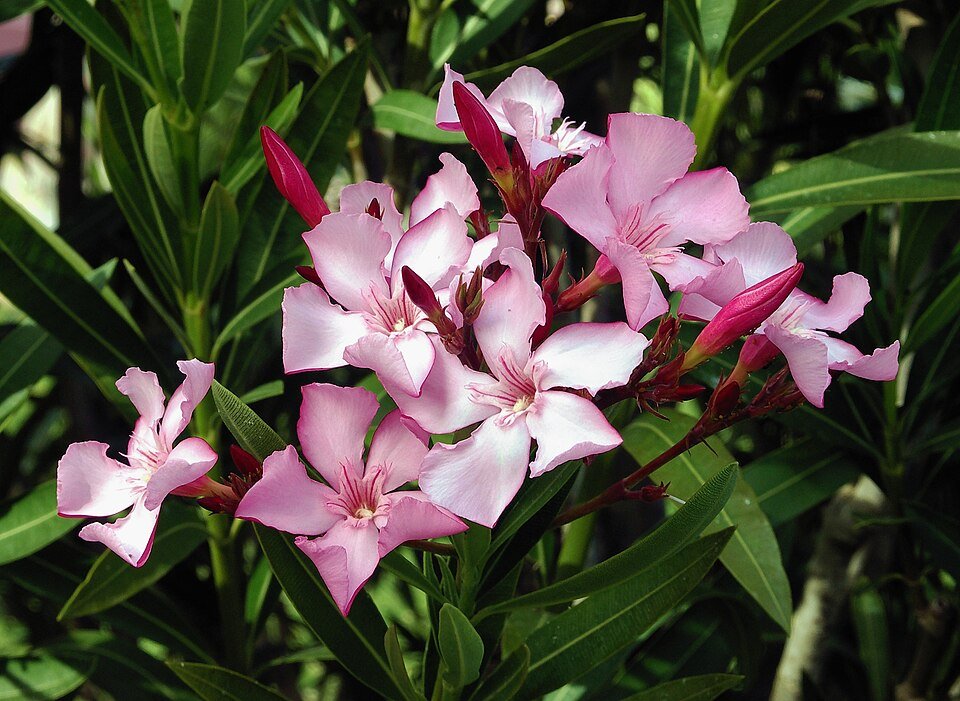
Apocynaceae
Apocynaceae Juss. comprises approximately 400 genera and more than 5,000 species, making it one of the largest families of Gentianales. Molecular phylogenetic studies have resulted in the incorporation of the former family Asclepiadaceae into Apocynaceae as the subfamily Asclepiadoideae, creating a broadly circumscribed and monophyletic family. Members are notable for their production of milky latex and a wide diversity of floral forms and pollination mechanisms.
Key characteristics
- Apocynaceae comprises annual and perennial herbs, shrubs, woody climbers, lianas, succulents
- Most members produce abundant milky or watery latex
- Leaves are generally simple, entire, exstipulate, and arranged oppositely or in whorls
- Inflorescences are usually cymose, terminal, or axillary
- Flowers are bisexual, actinomorphic to slightly zygomorphic, pentamerous, and sympetalous
- Stamens are epipetalous
Distribution
Apocynaceae is distributed throughout the tropical, subtropical, and warm temperate regions of the world, with centres of diversity in tropical Africa, Southeast Asia, South America, Madagascar, and Australia. Members occur in rainforests, dry deciduous forests, savannas, deserts, coastal habitats, and mountainous regions. Several genera have become widely cultivated and naturalized far beyond their native ranges. In Pakistan, Apocynaceae is represented by numerous native and cultivated genera, including Calotropis, Carissa, Catharanthus, Ceropegia, Nerium, Rhazya, Vinca, Cynanchum, and Pergularia. Species occupying habitats ranging from deserts, dry scrublands, and saline plains to riverbanks, cultivated fields, subtropical forests, and montane valleys. Xerophytic species such as Calotropis procera and Rhazya stricta are particularly characteristic of the arid and semi-arid regions of southern and western Pakistan.